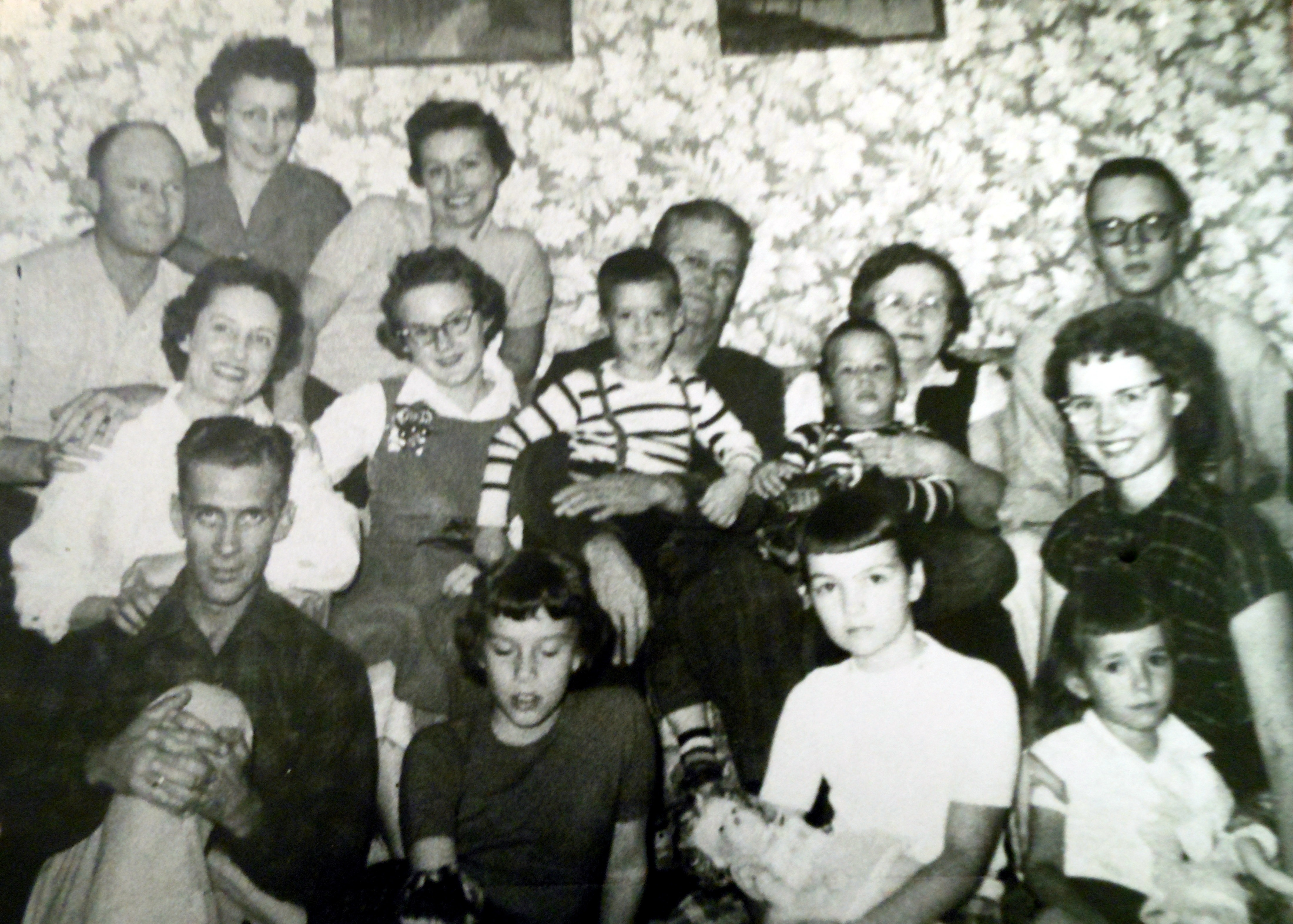
This is my clan, the Benskins, the kin of Ben, some forgotten Scotsman whose wandering descendants wound up a hundred years later in Texas. It’s Christmas, 1956, at my grandparents’ house, a year after my parents’ split. I’m down front with my sister, high-water bangs and dolls. Everyone’s there, frozen in time against an explosion of floral wallpaper.
When I look too long I see the future, and I wish I could warn them, help them by-pass the common sorrows of divorce and alcohol abuse. Mental illness will come, the drug culture, confused sexuality. Children will be buried, there will be a suicide, and even a murder. It adds up in every family.
When I was young, I saw Ruby Benskin, my grandmother, as a harpy in a hairnet, like a cafeteria worker determined to pile your plate with something green and squirming. When she came to Texas City for a visit, there better be Dr. Pepper in the refrigerator, or there was hell to pay. She talked a lot about the Lord, and I thought the Lord crafted Ruby and Charley Benskin from the hard-packed, intractable clay of San Saba County, and at the moment of creation they looked exactly as they did in old age, drained and done-for, never young, always raving or silent, opinionated, bigoted, suspicious, and stubborn.

Ruby Ella Long Benskin
My grandfather Charley (as he spelled it) was a study in passive aggression. At my grandmother’s vicious tirades, he would turn his back, knowing she preferred the high dudgeon of confrontation. If my parents’ marriage hadn’t scared the romance clear out of me, my grandparents’ marriage, a battleground of misery, would have.

Charels Wesley Benskin
When my mother and her sisters dismantled the house occupied by Ruby and Charley for five decades and more, they found nothing of value, but priceless treasures: World War II ration books. A letter, December 28, 1935, from the Texas City National Bank refusing my grandfather an FHA loan, and asking for $1.50 to cover the cost of the appraisal. My grandmother’s driver’s license, with an unusual restriction. Old love letters and years of school pictures, kids, grand kids, nieces and nephews. Telegrams and photo portraits, mysterious and unidentified.

Driving Restrictions If Any: With Pillow.
Instead of tossing it all away, my mother and her sister Jinx made a good decision, one I’m grateful for. They decided this cache of memorabilia deserved a scrapbook, 30 years before “scrapbooking” became a popular hobby.
Eventually the scrapbook came to me, because (according to Jinx) I seemed to love it, and because I was the only cousin who was interested. That last part isn’t true, but the first part is. I loved the scrapbook, and I resolved to take good care of it. However, the materials, an accountant’s ledger and scotch tape, weren’t well-chosen for the purpose, so when it began to deteriorate, I decided to digitize the material and produce an on-line equivelant. It would last forever and be available to anyone who might be interested.

A page from the original scrapbook.

Cover of the digital book, with a picture of the original accountant’s ledger.
I worked in the dining room at the back of the house, where it’s quiet and there’s soft light from the garden window. The task became a ritual as I opened letters, looked for dates, found clues in old photos, deciphered faded handwriting. I saw things I’d never seen, and slowly, 20 years after they were both dead, I began to know my grandparents.

The Long family. Seated, Ella and Jack with Ruby on his knee. Standing, Lucy Ray, Mary, and Archie.
Ruby Ella Long
Ruby wakes up to the sound of her father’s sobs. It’s dark, but she crawls from the heavy warmth of her bed to the freezing floor. She walks to the door of the room she shares with her sisters, and she sees her father hunched at the kitchen table. A candle is the only light, and he holds a pencil. He writes and sobs, writes and sobs, and then he stops, blows out the candle and goes to bed. He doesn’t see tiny Ruby, so she returns to bed and imagines her mother’s arms around her, knowing she will never see her mother again.
Ruby’s up again at daybreak, ahead of Mary or Lucy Ray, who will make breakfast and set coffee on. Their mother is dead, and only 31 years old.
A photograph rests on a low table, in a black cardboard frame with an arm on the back, so it stands upright. The family in the photo is whole – Ruby on the lap of her father, John Long, her mother gaunt and wasted with the disease that will end her life. Mary has one hand on her mother’s shoulder, and Lucy Ray is next to Archie, the only son. Ruby was four years old then, and she’s just turned five. Lucy Ray comes into the kitchen, picks up her father’s letter, and reads:
“Cherokee, December 8, 1899
Dear Ella,
One month today you left me, and oh how long it has been to me. I sit in this desolate home bowed with grief and Ruby crys Mama gone to heaven and left us. Oh Ella I feel like I will have to run away but when I look at your poor little children I can’t leave them oh what will I do how can I stay here without you.”
As tears run down Lucy Ray’s cheeks, Ruby cries. “Is Papa gonna leave us, too?”
“No,” says Mary.
Brother Archie deserted the family as soon as his mother was buried. John Long didn’t, though he never recovered from his wife’s death. When he died in 1915, this was his obituary.
“J. J. Long of Cherokee died Saturday . . . and was buried beside his wife . . . He leaves three daughters . . . Mary, Lucy Ray and Ruby. Three nobler daughters never graced a Texas home. Deprived of a mother’s love and care and guidance, with a stricken father, . . .they uttered no complaint, with the courage of a martyr they took up life’s work where it was left them by a merciless fate . . . earning a support for themselves and their helpless father, they used every spare moment to improve their talents, and Miss Ray qualified herself for the teaching profession and Miss Ruby recently graduated as a stenographer from a prominent commercial college. Miss Mary has given the best years of a young life in devotion to father and home. Brave hearts, noble souls, every heart beats in profound sympathy and adoration for you and yours.”
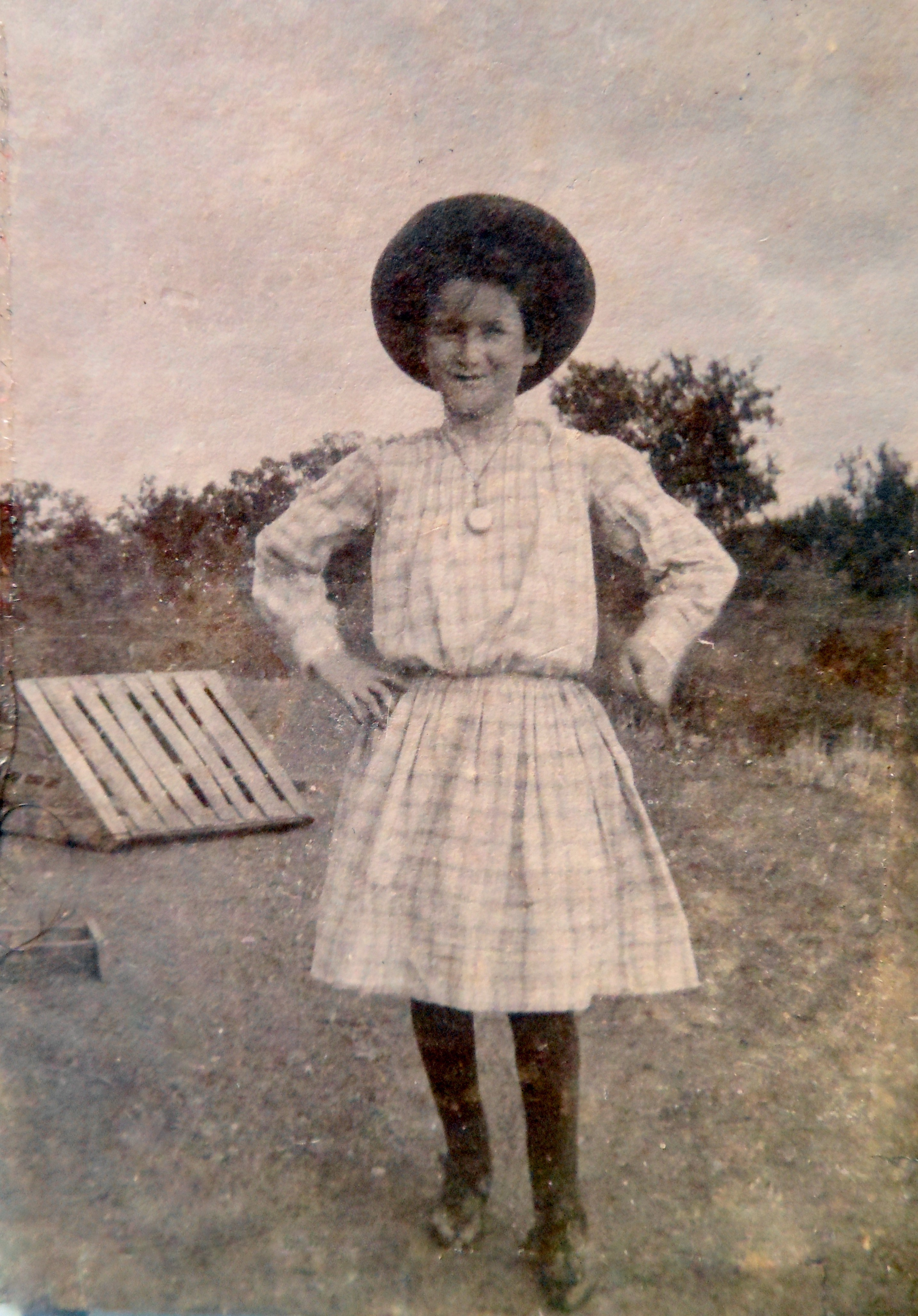
Miss Ruby Long in Chappel, Texas.
Ruby was a stenographer? And a “brave heart, noble soul?” It was shocking to know she wasn’t always what she became. I wish I knew what she was thinking in this picture, at 13 years old, her arms akimbo, gingham dress and sassy hat.
She never smiled in photographs, and my mother said it was because she had ugly teeth before she got a full set of false ones. Old photos are full of non-smiling people, and even though it was common to be serious, I wonder how many simply had unattractive teeth before chlorine and regular visits to the dentist.

Sam, May 6, 1913. He looks like James Dean, who hadn’t been born yet.
When she was of an age to be courted, Ruby had two suitors, Sam and Charley. I found a letter from Sam, postmarked 1914, in pencil, barely legible now: “. . . Darling why don’t you write long sweet letters like you use to write me. I don’t think you love me. I am afraid there is another in the way aren’t they kid tell me the truth if you have changed . . .would you rather talk to Charley than to write to me?” In long sighs as an old woman, my grandmother sometimes whispered, “I should have married Sam.”
Her other suitor was Charley, but I found no letters. Was Sam far away and Charley right there in San Saba County? That’s a common reason why one suitor wins out over another, but for whatever reason, Charley won the Ruby Ella sweepstakes, or lost it.
Charles Wesley Benskin
Charley has brothers and sisters aplenty, 13 were born, 11 survived, and times are hard. There’s enough to eat, but just, and the family depends on the game the boys bring home. The older ones get deer, mostly, and the younger ones, like Charley, hunt squirrel and sometimes wild turkey.

Handsome young Charley.
Charley’s hunt begins like any other. He’s deep in the woods, a long way from town, and a long way from home. Something goes wrong. The gun discharges, and Charley jumps. He doesn’t feel anything, so he’s startled to see his shredded work shoe, blood oozing around the laces. Now it hurts, badly. He sits down to think, then he acts on what he knows. No one will look for him, not today, and if they do, they won’t know where to start. He sees no smoke rising in the trees, so no other hunters or cabins. The nearest neighbor is miles away.
With his shirt, he binds the foot as best he can and walks, using the gun as a crutch. He walks and walks, through pain and delirium. By the time there’s a doctor, he’s bled too much. He’s lucky to be alive, and he’s unconscious when he reaches a hospital. When he wakes up, his leg is gone at mid-calf. He’s 12 years old.
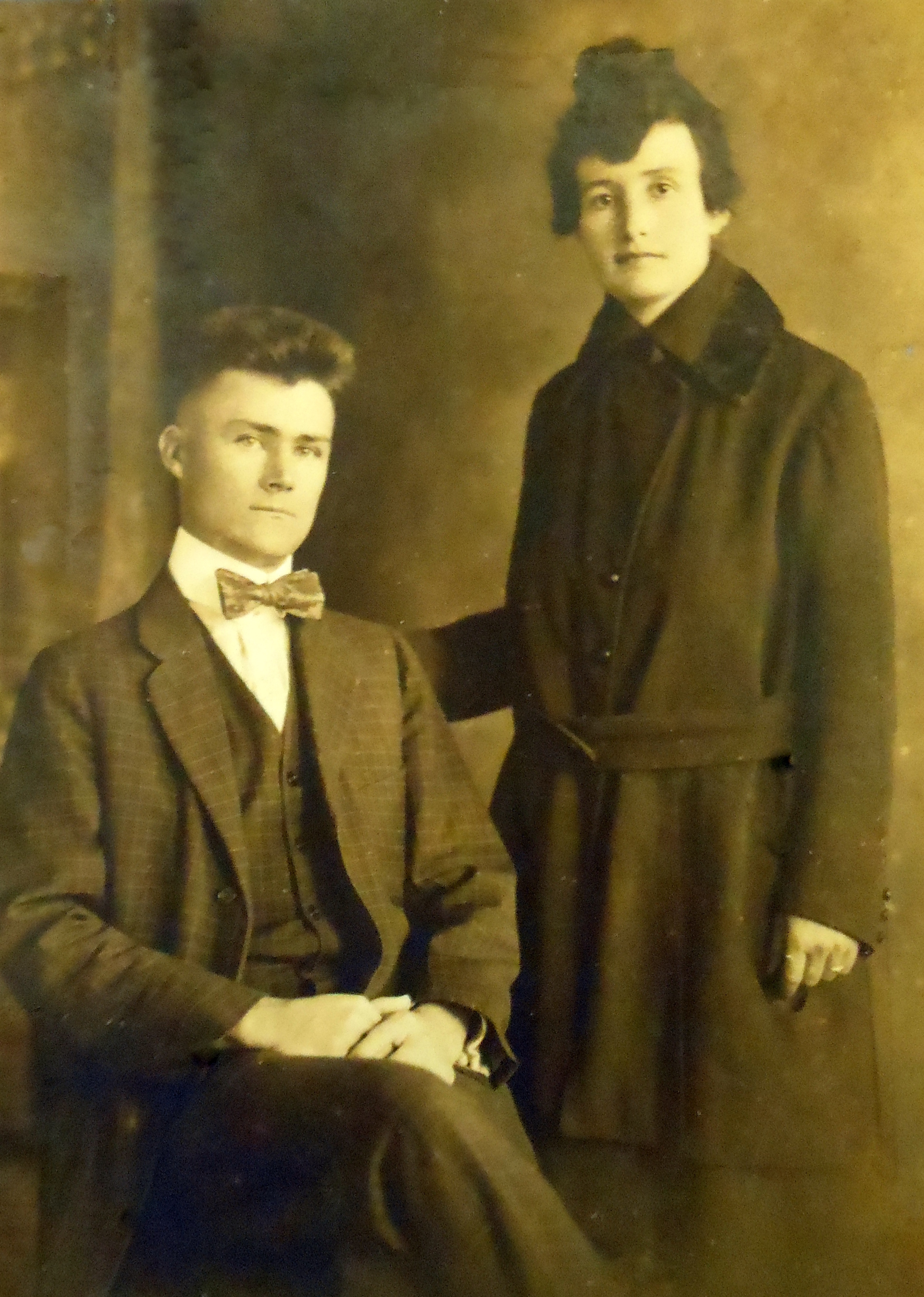
Charley and Ruby as newlyweds.
She was Ruby Ella. He was Charles Wesley. Then they were Ruby and Charley until she died in 1973. They once were beautiful and young. Well-turned out, their hair-dos the height of fashion.
I don’t know why Charley became a barber, a profession requiring him to stand all day. He limped, and his stump was painful. A prosthetic leg back then was a hollow tube he strapped to his hip and waist. It chaffed, and the sores often became infected, yet I never thought of him as a cripple, because he didn’t. Perhaps he became a barber because it didn’t occur to him there was any reason he shouldn’t.

Charley cutting his brother Grover’s hair.
Judging from the photo, he took up barbering early, or maybe it’s a coincidence, one brother cutting the hair of another in poor rural Texas.
Shortly after they were married, the young Benskins left San Saba County, so Charley could go to barber college in Galveston, and after that, Texas City seemed like a good place to make a living.
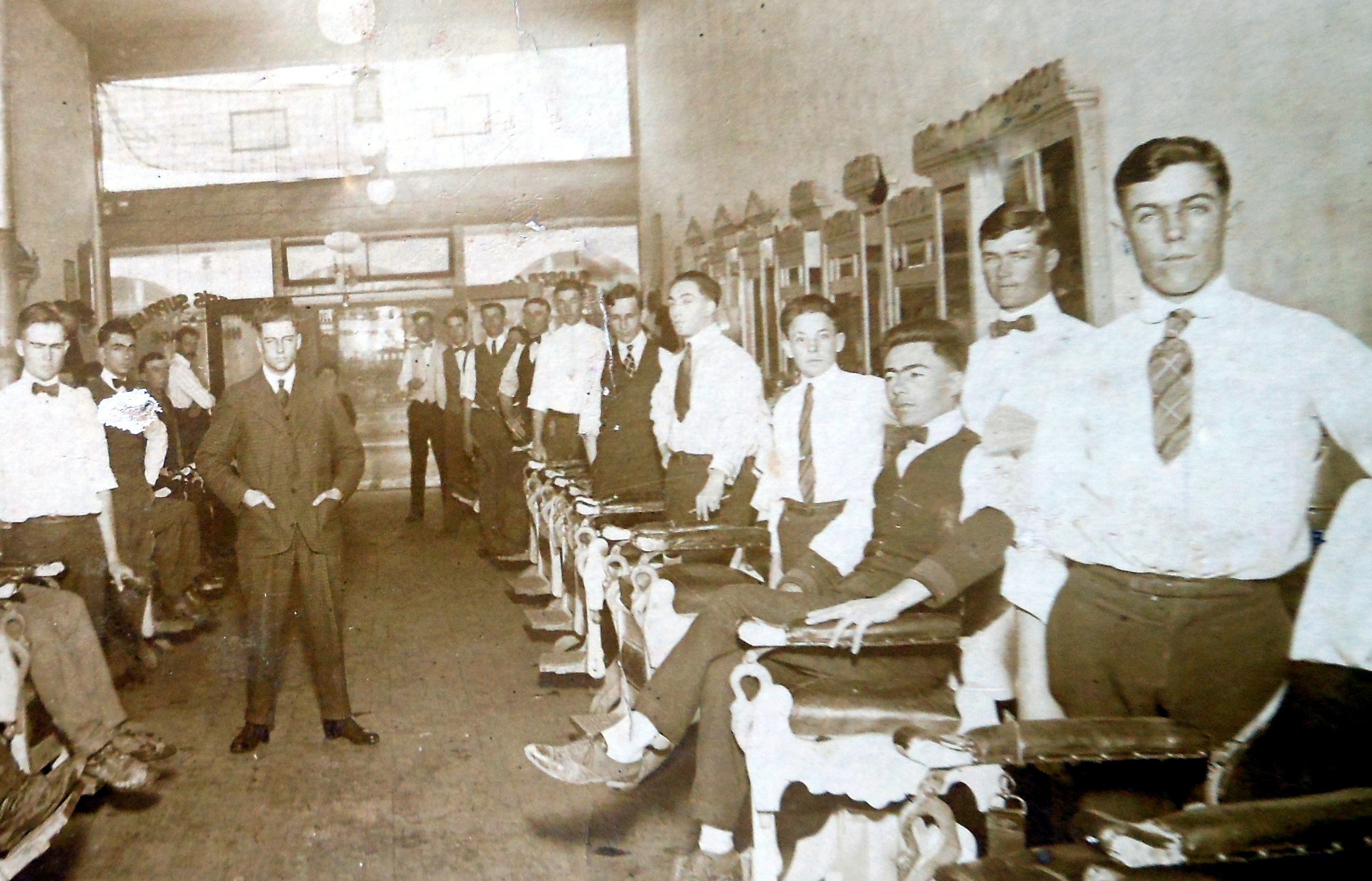
Standing on right, in bow tie, Charley in barber school.
Charley opened the Star Barber Shop on Third Street, and a friend remembers the shop. Wayne’s mother called and gave “Mr. Benskin” specific haircut instructions, but the little boy had a better idea. A burr haircut would last all summer, and he could pocket the extra haircut money.
He showed up alone and convinced Mr. Benskin his mother had a change of heart, and a “burr” was agreeable to her. When Wayne got home, Mom came down like the Inquisition on her skin-head kid, and his plan fell apart.
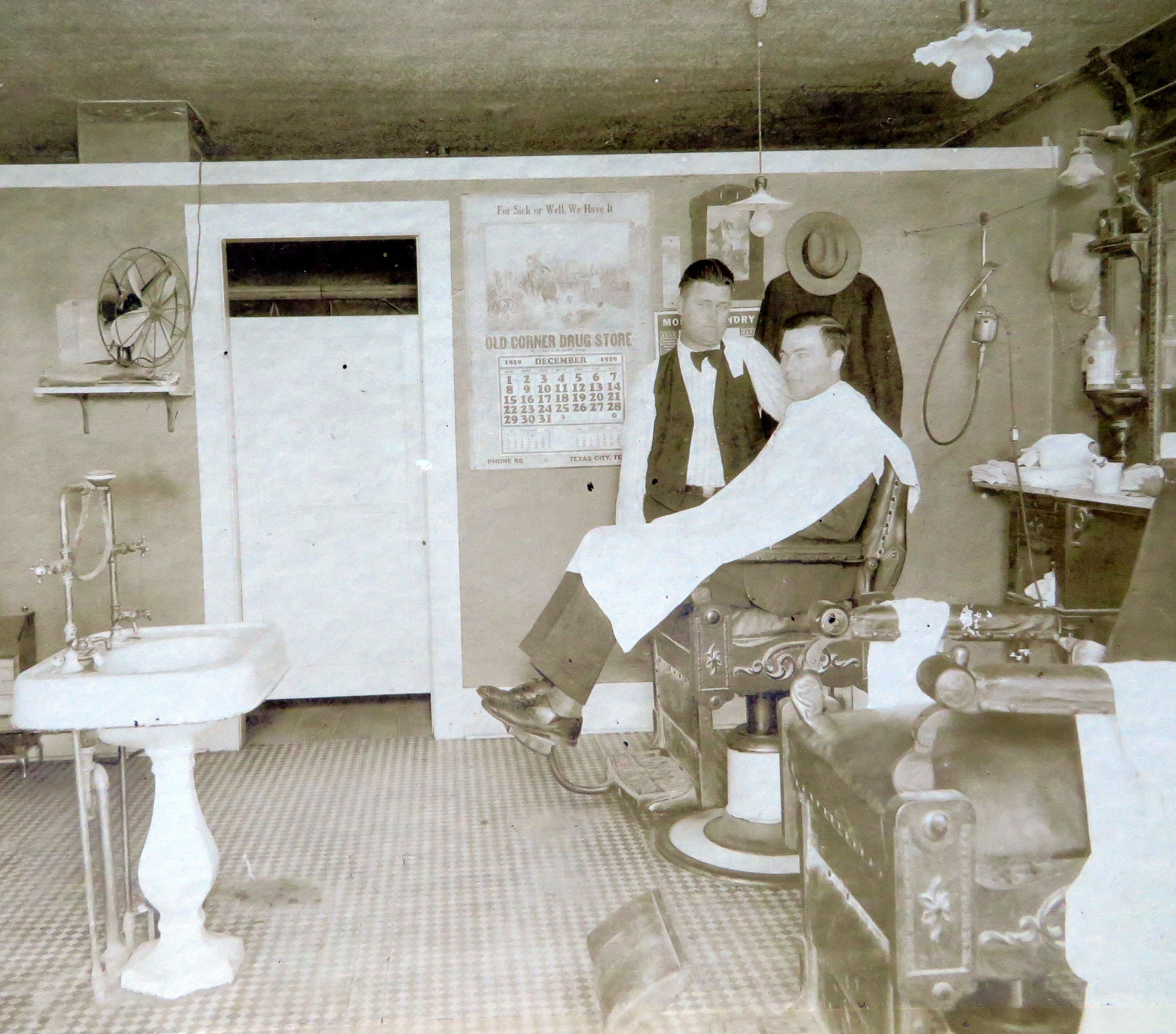
He was sent back to The Star to confess his lies and apologize to my grandfather. The incident made Wayne so “burr-phobic,” he couldn’t even bring himself to get a flat top in high school. Here’s a picture of Alex Wayne Pearson, standing in his front yard on Third Street. (FYI, he’s the uncle of Sherry Longshore, TCHS Class of ’64.)

Wayne, the scamp who got caught.
Charley was a respected businessman, but he clearly had a sense of fun. That’s him below, in drag, with Ruby’s sister Mary.
Ruby joined ladies clubs, and participated in community theater. According to a newspaper clipping, Mrs. Benskin was outstanding in Bound to Marry, a Three-act Comedy by Walter Richardson. Other old photos show the Benskins socializing with families called Graff, Pearson, Marshall, and Cross, names still around Texas City when I was growing up.
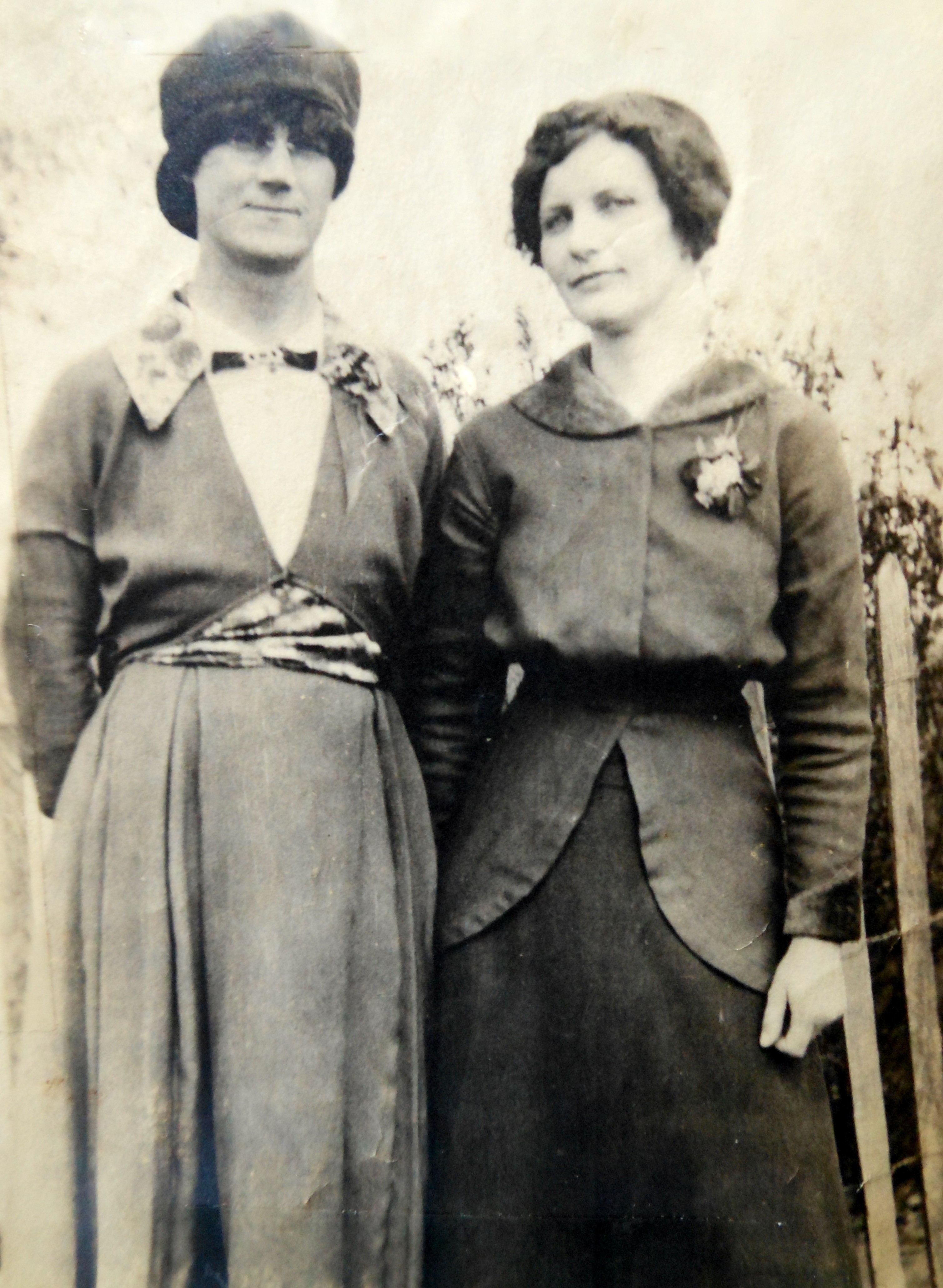
Charley (left) and Mary Long.

Paragraph of a review in the local newspaper, mentioning “Mrs. Benskin.”
The Benskin daughters grew up in TC, participating in the May Fete, working on the school paper. Given her community activities, and the pride Ruby probably took in being Mrs. Benskin, wife of the owner of the Star Barber Shop, it’s small wonder she didn’t want to go down in the 1930 U.S. Census as Ruby “Bruskin.” She kept the newspaper review of her performance, and the announcement of The Star Barber Shop, tucked away in her things for 62 years.

The Benskins coped with the Depression, when things weren’t easy. Walking with her friends one day, my mother saw her father driving a horse-drawn garbage wagon down Texas Avenue. She waved, but he turned away. He told her later he didn’t want her friends to know her father drove a garbage wagon for a little extra change.

Hazel (the Butterfly), Jackie, Ruby, and Jinx, Easter 1933.
According to my mother, even in hard times, Ruby laughed and sang, and enjoyed going around Texas City with her three fine daughters, my mother (the Butterfly), and my beautiful aunts Jinx and Jackie. With war on the horizon, the Depression waned, so what caused my mother to be so miserable at home she married to get out? They were a happy family before, said my mother. Before what, I asked? Before the babies, my mother said.

Ruby with Charles.
Just as times got better, money a little less tight, more freedom from the responsibility of raising her girls, Ruby became pregnant at 42. And again at 43. Two babies, a peculiar kind of tragedy, because it’s also joyful, thus mixing every possible emotion.
This made a wreck out of Ruby. She cried for days on end, and when she wasn’t crying, she was screaming at her older daughters and heaping hell on Charley. No doubt she suffered from postpartum depression, and probably a nervous breakdown, with no help nor understanding, and nowhere to turn. Only recently has this disorder even been discussed. In the 30s, Ruby kept silent for fear her friends and neighbors would think she was neurotic or insane.
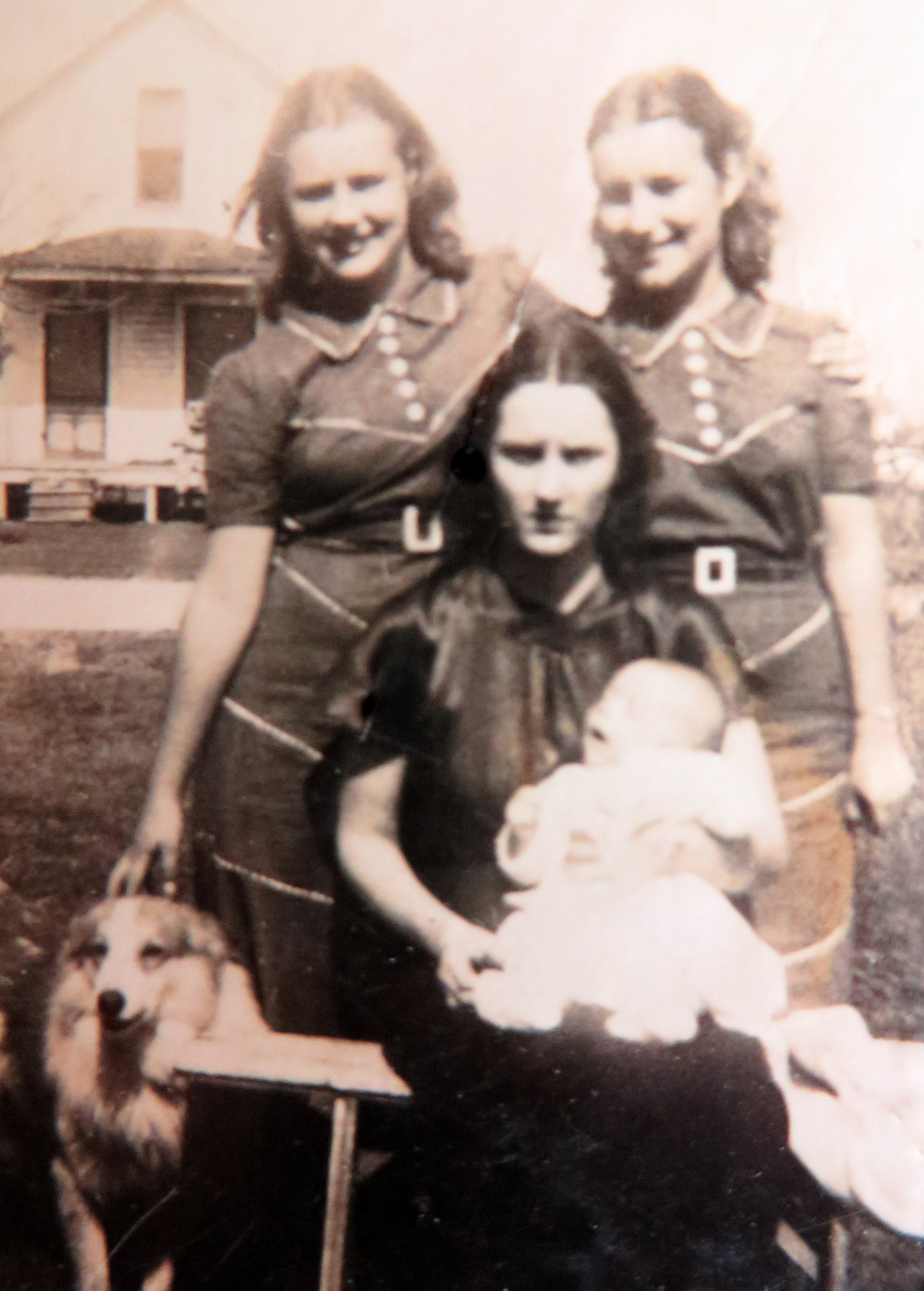
Hazel and Jinx (twin dresses), Jackie with Ray, and Fuzzy the family dog.
My mother accepted an offer of marriage, and my Aunt Jinx decamped as soon as she could. My Aunt Jackie had married, and in photos with her new baby, lovely Jackie looks troubled. Her own mother was physically and emotionally unavailable. The excitement of a first grandchild never came. Ruby’s son, Charles Wesley, Jr., was born November 29, 1937, Jackie’s son was born March 3, 1938, and my grandmother’s last child, Violet Elaine, was born December 22, 1938.
So Ruby and Charley had made a good life, beyond what their beginnings might have predicted. They were intelligent and ambitious, and they were by any measure successful in the context of the times.
But it was the times that did them in. In 1938, Ruby would have been called insane. Today, she might get the treatment she needed.
And Charley either began to drink or ramped it up. Who wouldn’t? But was he drinking before the babies? Or only after? Was he an alcoholic? Or did Ruby over-react? If Charley was an alcoholic, he had no where to turn. Alcoholics Anonymous was born in Akron, Ohio, in 1935, but didn’t exist across the country until 1941. At the time, heavy drinking was accepted among the men-folk, even encouraged, just part of “boys being boys.”
One way or another, Ruby was relentless. She demanded a geographic cure. Harangued to the point of despair, certainly to the point of capitulation, Charley closed the barber shop. They left their friends and active social life, and returned to San Saba, a dry county, where folks went to the next county to drink (making drinking and driving a way of life). The only happy times they knew, in Texas City, ended, but the worst was ahead.
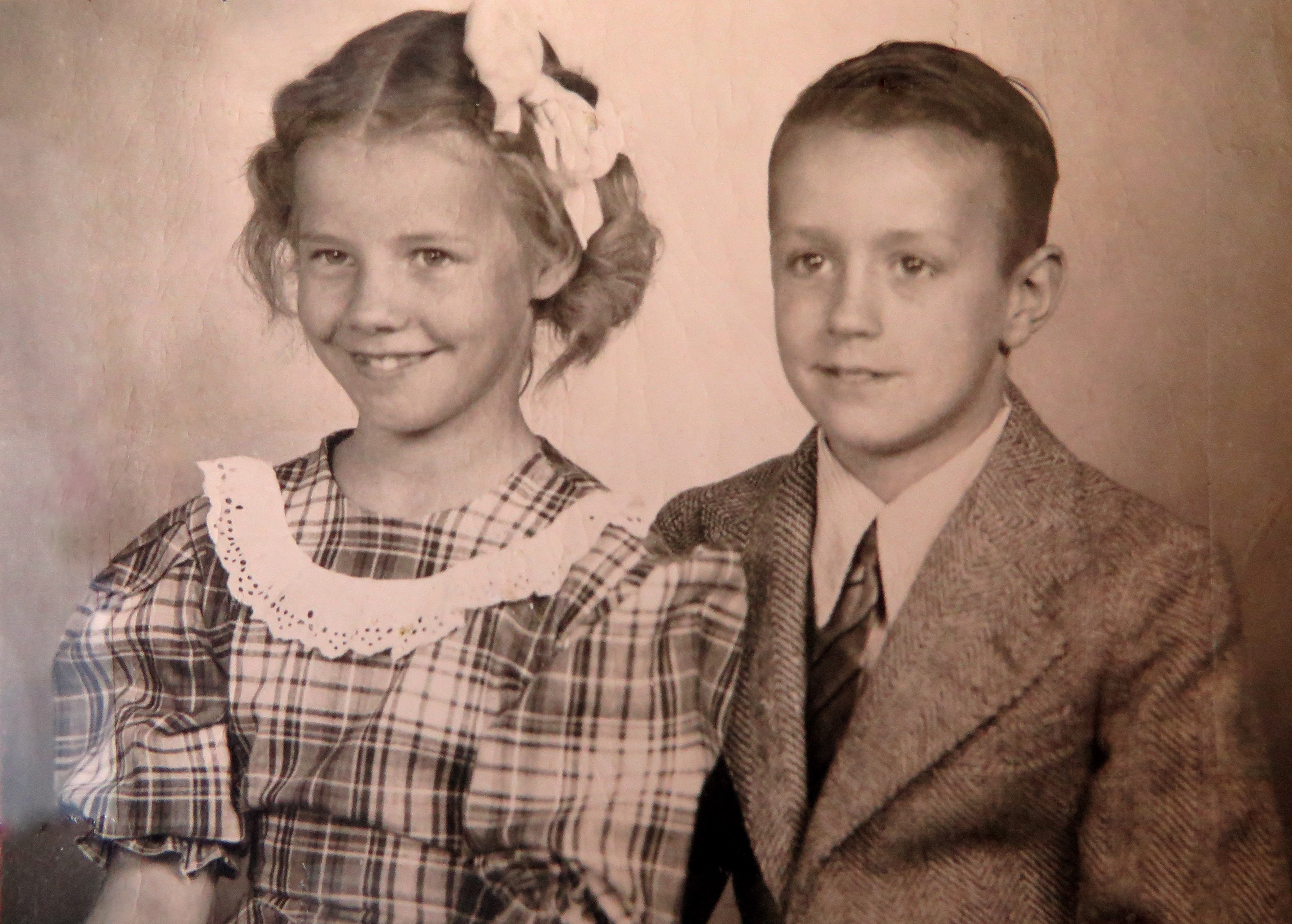
Violet and Charles, circa 1949.
The last blow came in 1950. Ruby blamed Charley – it was the wrath of the Lord for his drinking. But did she wonder, heart-broken, late at night, when she couldn’t sleep, what part she played in God’s vengance? If they had stayed in Texas City, as Charley wanted, would it never have happened?

Ruby, the day of Charles’ funeral.
My Uncle Charles, playing in the backyard with his sister Violet, followed a ball onto Highway 190, and just like that, his story ended. Like Charley at the time of the hunting accident, Charles was 12 years old.
This loss was unbearable. Although Ruby lived for 23 more years, and Charley for 32, I don’t believe they ever knew another day of happiness. They over-came many challenges, until the final one that broke them, the death of their only son, and the guilt they must have felt, no matter that it was no one’s fault.
My Grandparents, Ruby and Charley Benskin, believed in the American dream, and they achieved it. They became better than their beginnings, but it got away from them. Imagine a different outcome. What if Ruby had been diagnosed and treated? Charley might have stopped drinking. And maybe if they hadn’t left Texas City, Charles would have played in his front yard on Second Avenue, where the fastest traffic was Fuzzy the dog chasing squirrels.
Ruby and Charley weren’t always bitter, old, hateful people. They were ruined people.

From the San Saba newspaper.
NEXT: Help Help Me Rhonda
 Tuesday in Texas
Any kin to Benskins in Texas City, Texas? Sylvia Smith
Sent from my iPhone
>
LikeLike
Yes, Ruby and Charley Benskin were my grandparents. Grover Benskin, who lived in TC for years, was my grandfather’s brother (my great uncle). Grover and his wife Venita had two sons, Jim and Don, who were my cousins. They both graduated from TCHS.
LikeLike
Kudos to you, Rebecca! For your research and narrative. Much of your entry today was unknown to me. It certainly embellishes the empathy I’ve always held toward our grandparents.
LikeLike
I pieced together a lot from the scrapbook, but my mother did tell me they were happy “before.” Today Grandma might get help with the problems she had after two menopause babes. The same thing with her false teeth. They gave her trouble her whole life, and look at our kids! My mother had a partial plate that drove her crazy. I have a head full of fillings and crowns, but all my own teeth. My kids between them have three cavities, small ones, easily filled. That’s what good dental care from the time you’re a year old will do. Not everything was better in the “good old days.” xxoo
LikeLike
Once Charles was killed Charley, my grandfather (Papa), essentially adopted my dad as his son. He taught the city boy to hunt. Even with is bum leg it didn’t stop papa from trekking through the woods to hunt. One of my fondest memories is when papa, dad (Raymond Morris), my brother-in-law (Phil Anderson) and I went hunting in Bend, Texas.
Alex Wayne Pearson is probably the father of Wayne Pearson, TC High School class of 1955, who was the editor of The Stingaree Tales for many years.
Another great article!
LikeLike
Thanks, Ray. I have a couple of pictures of you with Phil and Papa hunting. I asked you and Bev independently what you remembered about why our grandparents left TC, and you both reinforced my memory of what I was told, though it was pretty vague. By the way, I meant to tell you, Shannon’s enjoying your FB “conversations.” xxoo
LikeLike
Good job. It was a difficult topic and you covered it well. I always wished that Grandmother could be happier and more optimistic but that wasn’t who she was.
LikeLike
Thanks, Bev. You know, I never really thought about how our grandmother’s pregnancies effected your Mother. And even if Grandma hadn’t been older, two pregnancies that close together can’t be easy. My mother said everything changed because of it. Does cause me to sigh deeply and agree with you. It’s too bad she couldn’t get better. xxoo
LikeLike
Loosing a child must be the most difficult experience for a person to deal with. My first wife died ay age 42 and her parents never recovered from her passing. I certainly have enjoyed your blog. Thanks, joe
LikeLike
Gosh, Joe, that’s tough. I guess losing a child is the worst, but losing a spouse must be a close second. It’s a long time ago for you now, but I imagine it changed you in many ways. Thank you for telling me this, and thanks for reading. Bec
LikeLike