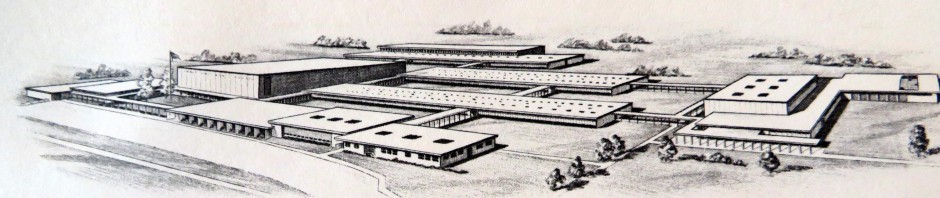
History, unpredictable, relentless, and over-whelming, and like water, benign until an earthquake raises a tsunami of change, and you adapt or get swept away, shredded. The class of ’64 would graduate into an unrecognizable world. And it’s always been so. My aunts, of another generation, all made a similar observation comparing the 40s to the 60s, and it was this, simple but powerful as water: “Things are so different now.”
 The mid- and late-60s shift in my head like a Kaleidoscope, but I keep a permanent vision of the summer of 1963.
Bright, smooth water, reflecting silver, disturbed only by the wake of a boat and the rooster tail from a single ski. Turquoise sky, winsome girls in bathing suits, strong boys, quick and agile. Even the sound of the motor vanished into white noise, refusing to disturb the tranquility of sky, water, and youth. We floated through time on an unchanged surface, forever. Even the songs had a water theme. Surf City. Surfin’ USA.

Lloyd
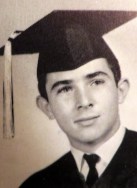
Rusty
Lloyd’s dad trusted him with a ski rig, and in the rosy hue of memory the boat is pink. Lloyd, Gene, Charlie, and sometimes Rusty, picked us up one by one, Sue, Jeannie, and me (Rusty never brought the same girl twice). They launched the boat on Dickenson Bayou, and I admired how careful they were, how conscientious of Mr. Lambert’s trust. They were men already, grown-up and responsible.

Sue
A short ride down the bayou to a place we called “the point,” to unload the cooler, blankets and towels. We skied and picnicked all afternoon, and when we were done we cleaned up after ourselves. We didn’t drink. We wore our life jackets. On the water, we kept the high-jinks to a minimum, though we were lively kids. Rusty road his skis over a grassy outcropping and right back onto the bayou, and I can see him yelling boo rah like the Navy SEAL he would one day be. Charlie skied way too close to a tied-up barge, trailing his hand along the top and scaring the dickens out of me. Long-legged Gene flew above the wake and made it look easy. The girls skied well enough, but none of us had the athleticism of the boys.
How could we have seen the swell of social change under such calm water?
This was my season of magical thinking. Nothing would change. I wouldn’t let it. My personal challenges were behind me – I managed life at Danforth and groped my way through Blocker Junior High. I accepted the abandonment of my father and experienced Hurricane Carla. Early in 1963 my mother almost died at Danforth Hospital of pernicious anemia, and on the way from Baytown to help me cope, my stepfather’s sister met a truck head-on out on Highway 45. She was killed, and my mother’s post-surgery care fell to me, until my stepfather could arrange to be relieved from his job on the river. I missed a week of school, and it was hard to make it up.
The Cuban Missile Crisis elevated fears of nuclear holocaust, but it didn’t happen, because our young, handsome, capable president would see that it didn’t. No one had ever heard of Vietnam, and we couldn’t have found it on a map if we had. So nothing bad could happen, and senior year would begin but never end.
I looked forward to August, when I would go somewhere at last. My only formal extracurricular activity was Junior Achievement, and my company, Mijet II, won first runner-up for best-managed among 674 entries. The prize was three all-expense paid trips to the National J.A. Conference at the University of Indiana in Bloomington. I was selected to go, along with Gloria from TCHS and Marie from LaMarque.
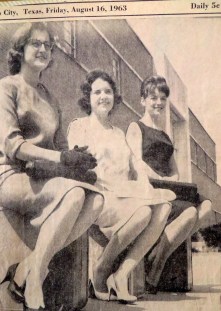
Gloria, Marie from LaMarque, and me. We made the TC Sun.
We flew to New Orleans, a first for all of us, and we joined a group of Achievers from Louisiana. From there we went by train to Indiana, picking up another group in Birmingham, and I got my first inkling of troubling times. The Birmingham police had set dogs and high-velocity fire hoses on its black citizens that spring, and the Birmingham group oozed ill-will, no doubt a reflection of their parents, and made remarks about what would happen if any of them dared enter our train car, sit at our table in the dining area, or speak to any of the white girls.
It may have been a beautiful summer on Dickenson Bayou, but 1963 was a hateful summer in Alabama, and when school started in September TCHS would enroll black students for the first time. I couldn’t picture that kind of hate on the faces of my friends.
Once we arrived on the Indiana campus, I was billeted in a boy’s dorm which was empty for the summer. The organizers, hoping to broaden our horizons, assigned everyone a roommate from a different part of the country, and mine came from Buffalo, New York. When I asked her about the white porcelain fixtures on the wall in the bathroom, she laughed out loud.
“Urinals, you hayseed. That’s where the boys piss.” She rummaged in her suitcase. “Where’s my sax. I can’t find my sax.”
Well, how was I to know? I’d never been in a men’s room, let alone heard a girl say that word. And she couldn’t fine her sax? Had she lost her saxophone? Her sex? What?
Miss Buffalo waved a small white ball in her hand. “Here they are! My sax!”
“Oh,” I said. “Your socks.”
I contemplated my broadening horizons. I’d heard of urinals and now I’d seen them, and some girls said piss right out loud. And maybe I was a hayseed, but at least I could pronounce the word socks.
I don’t remember one thing about our organized J.A. learning sessions, but I remember someone blew a toilet off the wall with a cherry bomb. In the talent contest, a kid played a moving violin solo, but a kid doing stand-up comedy won by a show of applause, proving high school kids preferred comedy to the violin. I ran into Jimmy Kickbush from Blocker (the boy Rhonda tried to steal from me). His family moved back east before high school, but there he was in the cafeteria line.
I remember the hateful atmosphere that boarded the train with us when we headed home and didn’t get off until Birmingham.
Gloria was the best thing about the Indiana trip. I knew her from school and from Junior Achievement, and I admired her easy-going temperament and her bravery when her brother Dwayne was killed in a traffic accident up on Bay Street. After the trip our friendship blossomed, and post-high school we shared an apartment in Houston for three years and many more experiences.

The last American Studebaker.

1964 Ford Mustang.
September closed in, and I was a sophisticated senior. After all, I had been all the way to Indiana! I had been on a jet airplane. I lived in an amazing world of touch tone phones and zip codes. Soon there would be bubble wrap! Yes, the world was changing, alright. The end of the Studebaker would be followed in the spring by the car of the decade, the Ford Mustang. All other troublesome rumblings would pass away because time had stopped for me.

Mary Lynne

Sherry
I loved Texas City High. Loved the well-lit hallways, polite students, and no-nonsense teachers. Whenever lining up was the order of the day, the unlucky alphabet placed me by Sherry and Mary Lynne (Long, Longshore, Lopez), and standing by these beauties, I imagined myself as a potato with a pony tail (oh, the insecurities of teenage girls). But they were both nice, and I got used to it.
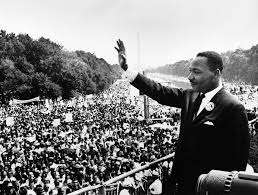
“I Have a Dream . . .”
I ignored the misgivings engendered by the Birmingham kids, and not long after the J.A. trip, I watched TV, enraptured, as Martin Luther King delivered his I have a Dream speech. It moved me, made me think my school might be OK.
And it was. The black students invoked a few negative remarks, but in TC explosions that killed 600 people were cause for concern, and hurricanes that devastated the town. A few black kids seemed like nothing to get upset about.
Now we could focus on important stuff, like football. Every Friday morning the sounds of the marching band bounced around the gym like the cheerleaders, and when “Dixie” became our de facto fight song, I never wondered if it was racist. The black students swayed and clapped with the rest of us, so maybe Dixie was (and is) just a great tune with catchy lyrics. What havoc political correctness reeks. As Freud famously said, sometimes a cigar is just a cigar.
The football game I remember best was at Baytown, and Charlie drove Linda and me to the stadium. Mid-game, with lots of time left and a few yards for a touchdown, one of the TC coaches (Koonce?) decided to go for a field goal, which Charlie and I thought a bad idea, but Linda pronounced it the right call. When we won by three points (17 to 14), she was vindicated, and winning meant more on that night, in that green season, than it ever would again.
As for my academic life, by now I was used to my mother’s spurious advice. Never wear your glasses (bad), don’t get pregnant (excellent), and then came two sentences on the subject of my future. She suggested after graduation (as if there would be such thing), I ought to go to Hollywood and become a movie star. Yes, she thought that a viable plan. I did not. She shrugged, Butterfly style, at my lack of interest in becoming a star, and offered the last advice she ever gave me, which was practical, and I took it.
“Well, if you don’t want to be a movie star, be sure you take typing.”
Why wasn’t I agitated about the future? Because in 1964 the pre-ordained path of girls was to be a nurse, a teacher, or a secretary until you became a wife and mother. I love these traditional roles, and I also respect the exceptions, but at the time only 11.7 per cent of men in the U.S. had a college degree, and 6.8 per cent of women. College for girls meant the coveted MRS Degree. Yet I had a secret ambition. I wanted never to get married and to be totally independent, but I couldn’t tell anyone. It wasn’t what I was supposed to want.
 On November 22, 1963, when things seemed safe, the earthquake occurred, and with it the rising tsunami of change. In my first post I described the knock on the door of Mrs. Neyland’s class, and the quiet way she told us of the events in Dallas.
There followed the bleak weekend of the funeral, and for a little while I wanted to hurry time, get past those dreadful days. When President Kennedy died, the 50s were done. Nothing would ever be the same, and even if our resilient hearts didn’t break, our intuition told us something was gone, and it wasn’t just our innocence. It was the innocence of a whole nation.
And even as we mourned, the future was being written, but I didn’t want to read it. In January the Surgeon General concluded smoking caused cancer. In 2005 cancer would take my sister’s life, and my mother’s (both heavy smokers). The Port Authority of New York and New Jersey released the designs for the World Trade Center, which would be built and would fall, and would change the country even more than the Kennedy assassination.
 After Christmas, things seemed marginally normal again, but in February Betty Friedan published a best-selling and controversial book, The Feminine Mystique. I read it, and I didn’t know what to think, but whatever the problem that had no name was, my Aunt Jinx had it. The coming feminist movement? You could have told me people would one day surgically change their gender, and I wouldn’t have believed any of it.
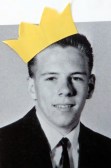
The King of Siam.
A huge irony occurred that spring. Not only was Mrs. Neyland’s class the place we learned of the worst event of senior year, it was also the venue of the most hilarious. She decided we would benefit by reading The King and I out loud, and Fred would read the part of the king. Adorable Fred, who looked about as kingly as Charlie Brown, but he gamely read the lines, and at Mrs. Neyland’s urging he put gusto into his work. This led to his downfall.
He was reading the scene in which the King emphasizes to Anna that HE is KING, and SHE only a lowly school teacher, and her head should never be higher than his. To keep it that way, he had some instructions:
“When I stand, you stand. When I sit, you sit.”
But this is what Fred said: “When I stand, you stand.” And then, with great emphasis and enthusiasm: “When I shit, you shit.”
I’ll never again see a human being turn that red. There ought to be a crayon called: Fred Red. He stood there wishing he was in Siam or dead, while his face became the reddest thing I ever saw, before or since.

Aunt Jackie looking very 60s on 21st Avenue.
The days slipped away, and my Aunt Jackie wanted to give me a graduation party, which terrified me. Would anyone come? March seemed way too soon, but Aunt Jackie said it was perfect. I wanted to go to Australia or be put in prison, anything to avoid this party which would be a failure. Instead, I agreed to the ordeal.
Did my aunt know she would guarantee my social season? I invited everyone I could think of to my Graduation Coke Party on 21st Avenue, and most of them came! I owed the good turn-out to the excitement of being the first graduate to be honored! Then I got invited to the parties of people who were invited to mine. Thank you, Aunt Jackie. My fabulous aunts. The one I love the most is always the one I’m thinking about. This moment, I love Aunt Jackie best.

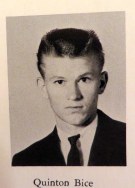 The same month Aunt Jackie gave me a coke party, Robert McNamara told President Johnson that 40 per cent of South Vietnam was under control of the Viet Cong. I knew nothing of this, and didn’t want to, but many of the young men of the class of 64 would know about it, and soon. Some, like John and Quinton, would not come back.
The tide that would wash away so much of what we knew and how we were raised was swelling, but we could remain untroubled for a little while. We could roll a few houses and stuff a few cars with shredded newspaper. Linda thought it was shameful to be seniors without ever skipping school, so we convinced Lana and Carolyn to do it. We went to Linda’s house because both her parents worked, and we anticipated trouble when the office called our homes. The office didn’t bother. They simply assumed we were sick. We were disappointed not to cause a kerfuffle, and surprised to learn going to school was more fun than skipping out.

Spring of 1964 and I still ignored the coming of graduation. It could never happen, because that would mean the end of high school. There was a huge private graduation party at the Elks Club, where the DJ played I Wanna Hold Your Hand about 20 million times. Charlie and I went to the dance at the Jack Tarr Hotel, to senior prom, and to Senior Night on the Town. And then, despite all my fantasies, graduation came. The most carefree days of my life were over.
Here we are, there ain’t no more! Yea seniors ’64.

May 1964.
Our class cheer, more prophetic than we imagined. The push of history works on all graduating classes, but not many grew up in a world that changed irrevocably just as we were grown – the civil rights act, the women’s movement, Vietnam, the drug culture. We weren’t prepared, and yet, to our credit, most of us made the adjustments we had to make.
So the class of 64? Are we happy and fulfilled? Is that a yes or no question? For most of us, it isn’t that simple. For most of us, the answer is yes. And no.
NEXT (AND LAST): The Rebirth of the Class of 1964, and Why It Matters.
 Tuesday in Texas
I sincerely hope you will continue your writing. I have enjoyed your perspective on many things in Texas City. It truly brings back memories of days gone by. Ken Mitchell, Class of 66.
LikeLike
Thanks for your kind comment. It’s a good feeling to know people have enjoyed and appreciated my work, and as for the writing? Who knows. Maybe I’ll continue in some way. I like to write poetry, too, even though very few people read poetry. Thanks again. Bec
LikeLike
If it all stops here, I will miss your writings. You stories brought back many memories and I have enjoyed getting back the memories. Your memory amazes me and I truly enjoyed each and every Tuesday. Thank you Becky and God bless.
LikeLike
These memories belong to all of us who grew up in that time and place, and so many of my youngest memories involve you. I could probably write a story about all of them. xxoo and xxxooo
LikeLike
You sure brought back some memories. I have to go be quiet for a while now.
LikeLike
oh God, I thought we might get through this without your telling that story. I know it has always been one of your favorites. (still a very useful word though, I figure I will have to explain to St. Peter one day why “Oh Shit” were my last words).
f
LikeLike
Oh, you did not think for a moment I could let this one pass! And yes, as the Brits would say, I’ve “dined out” on that story for years! It’s strange — I’m not sure I remember many more specific moments in specific classes at TCHS, one or two maybe, but the two I remember best came from good ol’ Mrs. Neyland. The story also high-lights what a different time it was. I’m still appalled at the language I hear on all the time, in public places, in nice places. I dislike it – it demonstrates how inarticulate many people are, if bad language is the best they can do. You had the grace to be embarrassed at what was really only a slip of the tongue. xxoo
LikeLike
beautiful just beautiful great job about one of the best years of my life!!! just mad i did get go with yall to dickinson bayou!!!! you sure had some fun!! thanks for the memories!!!
LikeLike
Thanks, Judy. I wanted to contribute something to the legend of the Class of ’64, that you and several other “key players” started. May the spirit of our class live forever (even if we can’t – smile).
LikeLike
I was so glad to see a picture of Rusty Girardin. He and his sister, Barbara, were the only two cousins I had. Rusty went off to the navy and I went off to the marine corps. I never saw him again, I wish I knew where he lived, I’d like to talk to him again.
I knew what happened to Quinton but I didn’t know that John didn’t come back.
I still have to deal with those memories, but I get my strength from the Lord and have been able to lead a normal life. Many are not so blessed. Please pray for all combat veterans.
LikeLike
I’m glad you enjoyed the picture of Rusty. We ran around in the same group at TCHS quite a bit. Also glad you’ve found some peace after the turmoil of those days. I’ll e-mail you privately about Rusty. It’s easy to get in touch with him, through our class group. At the time of our 50 year reunion the address he gave was in Oregon.
LikeLike
How did I miss the Tooley moment! Where the hell was I? I had Ms. Neyland too…..I remember Francine Holland told me how Ms Neyland asked her one day….Thrancine, how’s Threda (Freda, her sister) and Francine said……”oh, Thine, Thine….” and I thought THAT was hilarious! Good one Thred!!!… I have so loved all your stories. Can it be true…only one more addition? I have laughed, cried, and celebrated my youth with these stories….they will be missed so much…sigh…Tuesdays won’t be nearly as much anticipated or fun anymore….Love you….Lila
LikeLike
Your kind comments mean the world. I’ll miss doing this, and I am going to see about publishing the stories in book-form. I have a busy year coming up, as I think we’re going to try to move into a condo before we’re too old to manage it ourselves. We’ve got a place picked out, but a lot of things have to fall in place. I’m also considering what other next steps there might be. I could write about many thing. We all could — sigh. xxoo
LikeLike
What a fun trip down memory lane. I can still see, in my mind, Rusty going over that little piece of land on his skies and right back into the water without skipping a beat. We were invincible! Can’t imagine why Gene refused to let his two daughters learn how to ski in that bayou.
LikeLike
Gosh, those were such good days and wholesome fun. I’m a little surprised Gene wouldn’t let the girls do it, but I suppose he was a “protective papa.” I remember the guys went home with Lloyd to clean up the boat and see that it was returned in good shape. They seem so mature compared to how long it takes some boys to grow up these days. Love xxoo
LikeLike
For me, this blog is as much about your writing as about TC. Please contine!
LikeLike
Thanks, Jo. That makes me feel really good. I don’t know what comes next, but we’ll see . . . xxoo Bec
LikeLike